01
Stop Waiting Ninety Minutes for a Tow Hook
Hook the line to a rated recovery point and drag your own truck onto firm ground in ten minutes. No dispatch queue, no hourly rate.

Stuck axle-deep with no tow truck coming? Rhinoval 12V winches pull 4,000 to 13,000 lbs onto a matching steel mounting plate.
Recovery gear gets judged on its worst day, so each Rhinoval spec below is a load-bearing one.
Hook the line to a rated recovery point and drag your own truck onto firm ground in ten minutes. No dispatch queue, no hourly rate.
The mounting plate is rated 2,000 lbs above the largest winch that bolts to it. Load the drum to its limit and the plate is not the part that yields.
The sealed low-profile control box shrugs off the spray and road salt that corrode open solenoid boxes through one winter.
Steel stores enough kinetic energy to snap back through a windshield when it parts. The green line drops to the dirt instead.
Flip the switch before the truck sits three weeks in a barn. The battery still cranks on the first turn of the key in March.
Run a real recovery in week one rather than a driveway tug. A 30-day return window through the retailer covers a unit that arrives dead.
Bolt the 4,000 lb winch to a UTV bumper or drop the 13,000 lb unit behind a truck grille; both share one raised-pattern plate.
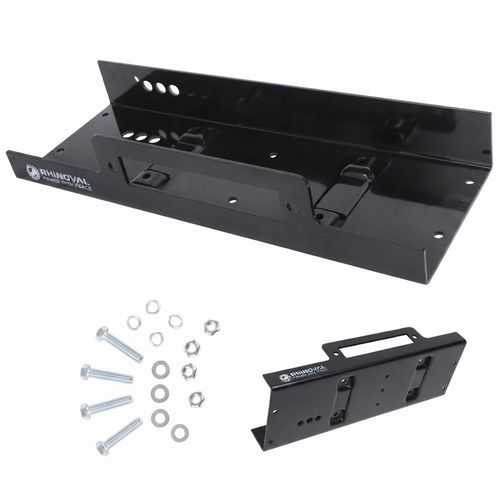
Bolt an 18 lb steel plate onto a trailer deck and a 12,000 lb winch sits flat on it, no washers stacked under the feet for clearance. Run a wrench around the base and the raised 10 x 4.5 in pattern has already cleared the bolt heads, so only the four plate-to-base holes get drilled and the deck keeps its structure. Where a flat universal plate traps grit and standing water under the drum after one wet season, this one routes the cable and drains through pre-drilled pass-throughs. Unpack powder-coated alloy steel, an integrated fairlead flange, and the bolts, nuts, and washers, then read one condition twice: not a direct bolt-on for a Jeep bumper.
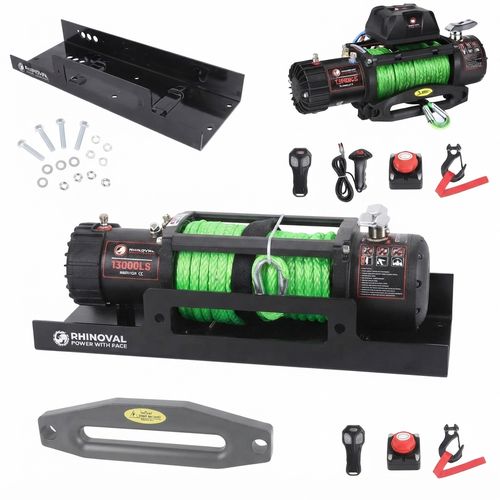
Green rope tracks against mud and gravel at dusk, so you watch the line instead of hunting for it. Drop the 13,000 lb winch onto the raised pattern under its plate and every bolt hole lines up on the first try. Hold the trigger through a long drag up wet clay and the 6.4 HP series-wound motor keeps building pull through a cold-extruded 3-stage gear train. Tuck the low-profile control box behind the center grille and the bumper still clears a plow mount. Where a winch bought alone leaves you measuring bolt spacing with calipers, the pair arrives matched. Sealed to IP67, it shrugs off a winter of road salt; flip the battery disconnect after each recovery, and send a freight-damaged unit back through the retailer's return window.
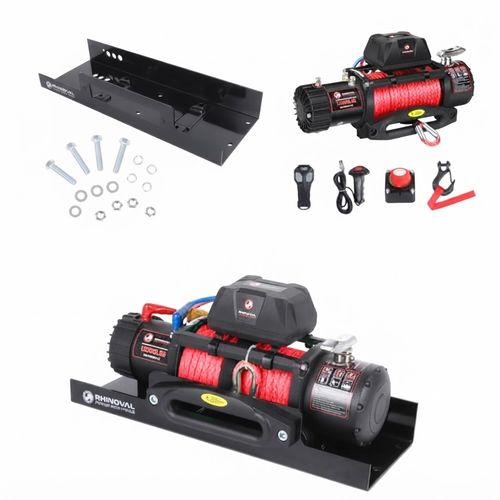
Shopping the winch and the plate separately turns into a caliper session on the driveway. Buying them together skips it: the 13,000 lb winch and its raised-pattern mount ship as one set, drilled to the same spacing. Feed the line to a truck buried to the axles and the series-wound motor pulls harder as the amperage climbs. The 3-stage gear train hands that torque to the drum, so the rope creeps in at a walking pace instead of stopping halfway. Where a bargain kit hands you a steel cable and a shrug, synthetic rope and dual remotes come standard here. Early buyers who bolted it up since March 2025 rate it 5 stars, on a review count still in single digits. Pull something real in week one, while the retailer's return window is open.
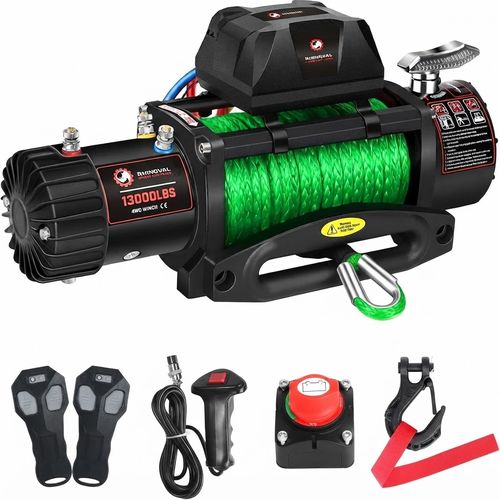
Winching a 5,000 lb pickup off a wet clay bank asks for torque that holds through the whole drag, not just the first foot. A 6.4 HP series-wound motor feeds a cold-extruded 3-stage gear train, and one owner reported pulling a 2023 Frontier clear without the motor grunting. Lift the 57.9 lb unit behind a truck grille on a Saturday and the low-profile control box tucks out of the airflow. Where a permanent-magnet unit fades as the amperage climbs, this one pulls harder into the load through the last foot. Unbox green synthetic rope, dual wireless remotes, a corded pendant, a battery disconnect switch, and IP67 sealing on key components, then check the 30-day return window before the first pull, backed by 34 buyers rating it 4.6 stars.
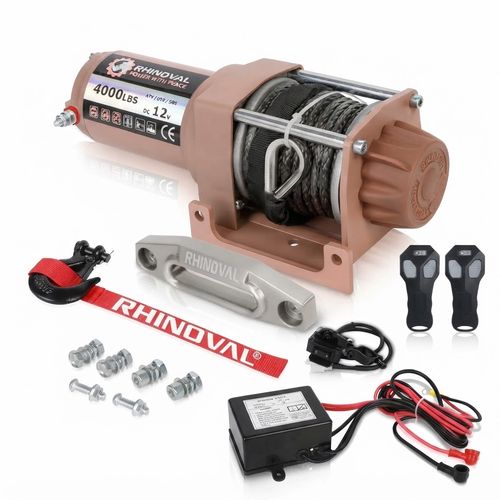
Lift a 13.9 lb winch onto a quad rack with one hand and the front end barely notices the weight. The mount plate is machined into the same housing, so the winch drops onto a rack and the bolts drive home without a second bracket. Spool synthetic rope rated to 6,600 lbs breaking strength back onto the drum after a mud-hole pull and it coils soft against a glove. Where a truck winch parks 57.9 lbs over the front axle of a side-by-side all season, this one stays proportional to the machine. Clip a long-range remote to your belt and work the line from ten paces off, with the 3-core corded pendant in the box as backup. Hose the Desert Sand housing down after a weekend in silt and the IP67 seal handles it; the engineered-to-IP68 claim is a manufacturer statement, not a certification.
Pull these figures off Rhinoval spec sheets and owner recovery reports before you order, including the ones buying guides skip.
| Figure | What it buys you | Source |
|---|---|---|
| 10 x 4.5 in shared bolt pattern | Bolt a 13,000 lb winch onto the matching plate and you drill four plate-to-base holes in an afternoon; the winch mounting holes stay factory-stock.Rival plate listings print a bolt pattern number and stop there, so you end up calipering the brand's own winch on the driveway. | Manufacturer spec: bolt-pattern and installation bullets |
| 6,600 lb breaking strength | Drag the 4,000 lb model's line across a rocky creek bed at full pull and it still carries a 6,600 lb breaking rating, 1.65 times the winch's own capacity.Bullet points call the line strong, then leave you guessing at a breaking-strength number next to the rated pull. | Manufacturer spec on the 4,000 lb winch listing |
| 6.4 HP series-wound motor | Scroll a winch listing for a horsepower figure and you rarely find one; the 13,000 lb winch prints 6.4 HP, so you size the motor against the load you drag that weekend.Buying guides argue series-wound against permanent-magnet for pages, then close without printing an HP figure for either. | Manufacturer spec: motor and gear-train bullets |
| 4.6 stars across 143 verified reviews | Owners bolt the mounting plate to trailer decks and drag downed tractors up onto them, and that plate alone carries 97 of the 143 reviews and ranks #8 among towing winch mounts.Unbranded winch listings in this class rarely show a verified review count this size after a year on sale. | 143 verified buyer reviews across the winches and mounting plates |
| 4,000 lb to 13,000 lb capacity spread | Winch a stock 2,500 lb UTV up a ramp on the 4,000 lb unit and it pulls with room to spare; hook an 8,000 lb mid-size truck and you need the 13,000 lb winch to clear the 1.5x margin.Buyers keep asking whether to size up or stay small, and most listings publish one capacity with no side-by-side for both ends. | Manufacturer specs for the 4,000 lb and 13,000 lb winches |
| IP67 rating (1 m / 30 min) | Ford a shallow creek mid-recovery and the sealed control box shrugs off dust plus a one-meter dunk lasting up to 30 minutes.Waterproofing rarely earns its own section in a buying guide; most bury it in one bullet with no depth or time figure. | IP67 rating under IEC 60529, applied to the control box |
Four situations where a 13,000 lb winch either earns its mount or exposes it, spec by spec.
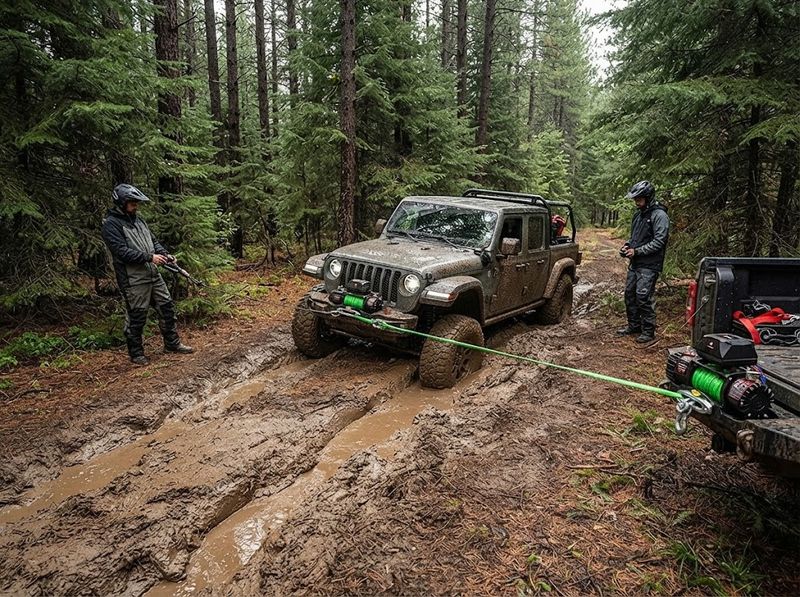
Rhinoval winches ship with a wireless remote plus a corded backup, so you work the drum from 30 feet off the rope line. A parting line throws energy along its own axis, and standing outside that cone is the cheapest safety habit in recovery work. The corded unit rides in the cab for the day a wireless coin cell dies mid-pull. On the 13,000 lb model two wireless remotes ship in the box, so a spotter holds one while you watch the anchor point.
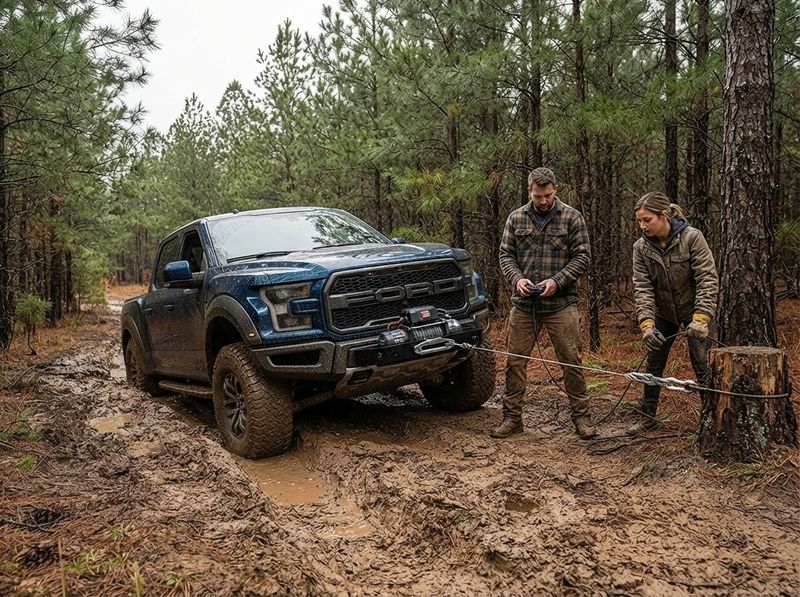
Set the Rhinoval mounting plate on a bumper and its 10 x 4.5 in raised bolt pattern takes any winch up to 15,000 lbs without a spacer block under the base. Run a finger under the mounted winch and the raised section has already cleared the bolt heads. Drill only the four plate-to-base holes and the base surface keeps most of its section intact. One caveat from the listing itself: the plate is not a direct bolt-on for a Jeep bumper, so Jeep owners budget for adapting it.

Hook the 13,000 lb winch to a bogged truck and its 6.4 HP series-wound motor feeds a cold-extruded 3-stage gear train that builds torque as the load climbs. Watch the drum through a long muddy drag and the pull rate holds instead of fading at the halfway mark. Cold extrusion forms the gear teeth under pressure at room temperature, so denser teeth run cooler than a cast train through a ten-minute pull. One owner pulled a 2023 Frontier clear of a bog and reported the motor never grunted through the drag.
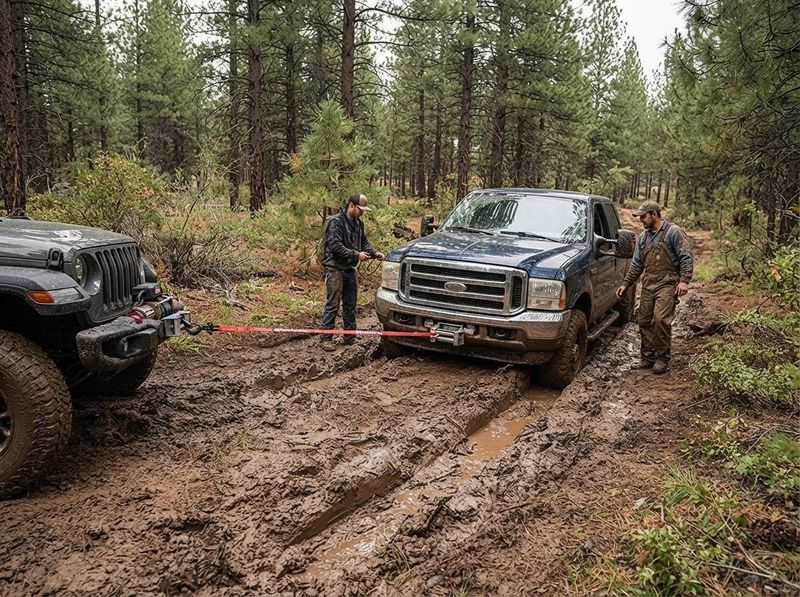
Rhinoval winches spool synthetic rope, which stores a fraction of steel cable's energy when a strand parts under an 8,000 lb load. Under IEC 60529, the IP67 mark on the control box means dust-tight, not submarine-proof: the listing warns against prolonged submersion. Rock edges are the real enemy, since abrasion cuts these fibers faster than steel, so a sleeve at the contact point earns its keep. Inspect the line every ten pulls and retire it once the outer fibers fuzz.

Rhinoval carries no history on a trail rig you have walked past, so a 13,000 lb rating from an unfamiliar name earns a squint before you click. Read the record instead of the pitch: buyers rate these winches and plates 4.6 stars across 143 reviews, most written after real recovery work rather than a driveway test. One trailer owner bolted a plate to a 24-foot deck and now drags downed tractors up it for shop repairs.
Your rear tires spin in ruts past the hub, and the nearest wrecker sits 40 minutes out. A 12V electric winch for trucks and SUVs turns that into a ten-minute job you run yourself. Size the 4,000 lb unit for ATV and UTV recovery, or the 13,000 lb winch for a mid-size truck. Synthetic rope and a matched raised-bolt-pattern plate come standard on both.
A Frontier owner buried past the rockers pulled clear with the 13,000 lb winch and reported the motor never grunted. Run that same 8,000 lb truck against the 1.5x gross vehicle weight rule and the 13,000 lb rating lands where the sizing math says it should. Hook an undersized 6,000 lb unit to the same pull and it sits at its limit within a minute, heats the solenoid, and stalls in the ruts.
The bolt pattern is where this brand splits from the pack. Order a synthetic rope electric winch and its plate together and both land on one raised pattern, so nothing gets shimmed on the driveway. Read the listing twice before you order for a Jeep: that plate is not a direct bolt-on for a Jeep bumper, so Jeep owners plan to adapt it.
How this brand startedFour holes drilled, one 12V feed run, and a remote paired: most installs finish inside a single afternoon.
Drill four plate-to-base holes, then torque the plate flat; the winch mounting holes stay factory-stock.
Route the low-profile control box leads to the battery posts and keep the grille opening clear.
Sync the wireless winch remote at the drum, then stow the corded backup in the glovebox.
Pre-tension the rope under light load and leave five wraps on the drum before the first recovery.
Nine buyers describe the pull that mattered, including the two who docked a unit for short control-module leads.
Perfect fit for my winch, and mine is a 12,000 lb unit. I installed this plate on a 24-foot trailer and use it to bring downed tractors up onto the deck for repairs at the shop. My winch and plate have never failed me. I did have a company make me an underside plate to reinforce it, because I don't trust wood alone to take the brunt of a 12,000 lb pull. Money well spent.
Absolutely fantastic mount. Measures 3/16 inch thick, and the winch mount location is pressed for added strength so no hardware protrudes past the bottom of the plate. I have it mounted to a wooden deck trailer with a 12,000 lb winch. I wish it came with oversize washers to hold better to the wood, though I will likely weld it onto a flat deck for the truck down the road.
Wasn't sure what I was going to get and I went in skeptical. The plate looks much better in person than in the pictures and the finish is clean. It feels very sturdy and my winch bolted down to it with no issues. A lot cleaner and easier than hacking something together myself. Would buy another.
Didn't want to use it, but I had to. Pulled my 2023 Nissan Frontier out and it didn't even grunt. The wireless controllers work flawlessly. Noise is about a 5 out of 10.
Tough, and it works a treat. Installed it and tried it out already on a real job. I pre-tensioned the rope per the instructions first. Installation did require an innovative mounting for the control box on my part, but only because of where I wanted it to sit.
Works well. Mine was missing the instructions and the template for the bolts, so I had to improvise the layout. The wireless remote is great and there is plenty of pulling power.
The winch is a great little unit and installation was a breeze. The only problem in my situation is that the wires from the control module to the winch itself are too short. That is why I rated it four stars. Customer service is spot on and very quick to respond.
This is a strong winch. It worked great to help pull our old lawnmower with the flat tires up the hill in the backyard. It came with everything we needed, including two remotes, and it connected easily to my husband's truck.
The harness hooked up really easily, since I was swapping out an old winch, and it bolted right up. It is quiet as these go, and I love the weight savings of synthetic rope over standard braided steel. Easy to put into place by myself because it is lighter and can be held in one hand.
The failures owners describe most often, and the Rhinoval spec or policy that answers each of them.
Steel cable failure sends stored energy back down the line at windshield height. Synthetic rope carries a fraction of that kinetic energy and drops to the dirt instead. Stand outside the rope cone anyway and throw a damper over the line before you pull.
Rope, not steel cable, ships standard on the winch models
Watch a permanent-magnet winch slow to a crawl halfway up a wet clay bank as the amperage climbs and the torque falls away. The series-wound motor pulls harder into the load instead of surrendering to it. Rest the drum between attempts anyway: electric winches generally run a 30 to 40 percent duty cycle.
30 to 40 percent duty cycle is the industry norm
Look for a published warranty term on these winches and you come up empty, so treat the first weeks on the rack as your own test window. What exists: the retailer return window on a fresh order, plus a Contact Seller channel for install and missing-part questions. One buyer whose control-module wires ran short reported an answer the same day.
Hook up at the rated ceiling on every recovery and the winch spends its service life at redline, which shows up as a burnt motor in season two. Multiply gross vehicle weight by 1.5 and shop above that line. An 8,000 lb truck lands on the 13,000 lb winch, never on a 6,000 lb bargain unit.
1.5x gross vehicle weight is the working minimum
One buyer ordered the compact winch for a quad, found the mounting face did not line up, and sent it back. Measure the face before ordering, then match it against the plate spec. The 30-day return window through the retailer covers the miss when your tape measure does not.
Two of the five above come down to measuring first. Pick a capacity, then check today’s listing before you order.
Five recoveries the 4,000 lb and 13,000 lb winches handle, from a trail mud hole to a trailer deck.
Anchor to a trunk with a tree strap, thumb the remote, and the compact winch walks a stuck side-by-side out in under two minutes.
Suction on a wet clay bank doubles the load a tire sees. The 13,000 lb winch drags a mid-size pickup back to the crown of the road while the driver stays behind the fender.
Bolt the plate to the trailer deck and run the line down the ramps. One person then loads a seized machine that two could not push.
Water over the axles kills a cheap open solenoid box. Sealed housings on these winches take a shallow crossing and keep answering the remote.
Four holes, two 12V leads, and one remote pairing. A first-time installer bolts the winch up before the coffee goes cold.
The first 30 days decide whether the winch stays, and the second winter decides whether the seals do.
Unbox on the tailgate, drill four plate-to-base holes, and run the 12V leads before dinner. Test a real pull inside the 30-day return window so a dead unit goes back rather than into storage.
First honest recovery instead of a driveway tug. Hook a bogged quad or a truck sunk to the rockers and watch the drum speed hold under load.
Rope check after roughly ten pulls. Run a gloved hand down the line, look for fuzzed fibers near the hook, and reset the five wraps on the drum.
Gasket and seal inspection before the wet season, plus the winter habit of flipping the battery disconnect switch whenever the rig parks for a month.
Ready for Day 1? The 4,000 lb winch racks on a quad by hand, the 13,000 lb unit needs the plate first.
Rhinoval builds 12V electric recovery winches and the steel plates they bolt to, spanning 4,000 lbs of pull for ATV and UTV work up to 13,000 lbs for trucks, SUVs, and trailers. Synthetic rope, a wireless remote, and a corded backup ship with the winch models. The plates carry a raised bolt pattern rated for winches to 15,000 lbs.
Multiply gross vehicle weight by 1.5 and treat the result as your minimum. An 8,000 lb truck therefore needs at least 12,000 lbs of rated pull, which puts it on the 13,000 lb winch. Mud suction, an incline, or a loaded bed pushes real resistance well past curb weight, and a winch working at its rated ceiling on every recovery wears out fast.
Truck and SUV owners who wheel on weekends, trailer owners loading dead machinery, and UTV riders who ride alone. The common thread is recovery without a second vehicle: one person, one remote, one anchor point.
The winch, synthetic rope already spooled, a corded remote, one or two wireless remotes depending on the model, the control box, and mounting hardware. The 13,000 lb models add a battery disconnect switch. Bundles include the mounting plate with its bolts, nuts, and washers. A wiring template ships with most units, though one owner reported theirs missing and improvised the bolt layout.
No license applies to a vehicle-mounted recovery winch in the United States for private use. Competence matters more than paperwork: know your anchor points, keep bystanders out of the rope cone, and throw a damper over the line before you pull.
Mass and mission. The compact unit weighs 13.9 lbs with a mount built into its housing, sized for quads, side-by-sides, and light trailer loading. The 13,000 lb winch weighs 57.9 lbs, runs a 6.4 HP series-wound motor through a 3-stage gear train, and mounts to a separate steel plate. Putting the truck winch on a UTV rack loads the front end all season for pull you will never use.
A come-along asks you to stand near a loaded line and crank, often for twenty minutes on a bad recovery. An electric winch moves you 30 feet back with a remote and finishes the same pull in two. Come-alongs still earn a place as backup gear, since they need no battery, but recovering a full-size truck with hand-cranked cable is slow and exposed.
57.9 lbs for the winch itself, measured at 20.9 by 4.5 by 5.5 inches. Add roughly 18 lbs if you mount it on the steel plate, which matters when you calculate what the front end carries.
A 6.4 HP series-wound electric motor. Series-wound designs build torque as current climbs, so resistance late in a drag makes them pull harder rather than fade. That behavior suits recovery work, where the hardest moment usually arrives after the rope is already tight and the tires start to break suction.
Gear teeth formed under high pressure at room temperature rather than cast or machined. The process leaves a denser grain structure, tighter tolerances, and less friction, which shows up as a quieter train that sheds heat better under sustained load. Three stages step the motor's speed down into the torque the drum needs.
Synthetic rope, standard across the winch models rather than sold as an upgrade. It is lighter than steel cable, stores far less energy if it parts, coils by hand without kinks, and does not rust from the inside after a water crossing. The trade is abrasion: rock edges cut synthetic faster, so a sleeve at the contact point is worth carrying.
The 4,000 lb winch states 6,600 lbs of rope breaking strength, roughly 1.65 times its rated pull. The 13,000 lb models do not print a rope breaking-strength figure in their listings, so check the current spec sheet before assuming a ratio. A rope rated well above the drum keeps the line from being the weak link.
Under IEC 60529, the first digit means dust-tight and the second means the housing survives immersion in one meter of water for 30 minutes. For a winch, that covers rain, road spray, and a shallow crossing. It does not authorize parking the control box underwater, and the listing itself advises against prolonged submersion.
IP68 rates continuous immersion beyond one meter, at a depth the manufacturer specifies. IP67 covers a temporary dunk at one meter for half an hour. In practice the gap matters only for deep fording; for creek crossings and weather, the IP67 mark is the relevant one.
The 13,000 lb models include one. It cuts the feed between battery and winch so nothing drains overnight and nobody spools the drum by leaning on a remote. Flip it whenever the rig parks for more than a week.
Both ship together. The wireless unit lets you stand outside the rope cone and still work the drum, which is the single biggest safety gain over a pendant. The corded remote plugs into the control box as backup for a dead coin cell or radio interference. The 13,000 lb winch ships two wireless remotes, so a spotter can hold one.
A 10 x 4.5 in raised pattern, the common spacing for truck and SUV winches. Rhinoval winches are drilled to the same spacing, so the plate and the winch match without adapters. Measure your existing winch's mounting face before ordering if you are pairing it with another brand.
The listing states 5 mm of steel across a 23.6 by 8.2 in footprint, and buyers measuring their own report roughly 3/16 inch at the winch pad, where the section is pressed for strength. Alloy steel with a powder coat, 18 lbs on the scale. For a 12,000 lb winch on a wooden trailer deck, several owners added a backing plate underneath rather than trusting wood alone.
The plate ships with an integrated fairlead flange, but the listing does not specify hawse or roller. Synthetic rope generally pairs with a hawse fairlead, since roller assemblies can pinch and abrade the fibers. Confirm the current configuration on the product page before ordering a replacement.
No warranty term appears on any of these listings, and that gap is worth stating plainly rather than papering over. What does exist: the standard retailer return window on a new order, and a Contact Seller channel through the order page for install and missing-part questions. Owners describe replies inside a day, including one whose control-module wires ran short.
Test it inside the return window and send it back through the retailer rather than fighting a repair. That is the practical argument for running a real recovery in week one instead of leaving the box on a shelf until spring.
Synthetic rope in the right diameter and length is a standard aftermarket part, and any hook or thimble rated above your drum works. For a brand-matched remote or control box, message the seller through the order page, since replacement parts are not listed separately. Buying a spare wireless remote up front is cheap insurance for a rig that lives outdoors.
Contact Seller on the order detail page routes to the people who ship the product. One buyer whose bolt template was missing improvised the layout, and another with short control-module leads got a same-day answer. Photograph the packing contents before you scrap the box.
The 4.6-star average covers 143 verified purchase reviews across the winches and the mounting plates. The plate alone accounts for 97 of them and ranks #8 among towing winch mounts. Two newer bundle listings carry only a handful of reviews each, so weight the older, higher-volume products more heavily when you judge the brand.
No UL, ASTM, or SAE certification is claimed on any listing, and none should be assumed. The IP67 marking references IEC 60529 for ingress protection, which is a sealing standard rather than a load-rating certification. Rated capacities here are manufacturer figures, so build your safety margin with the 1.5x sizing rule rather than a certificate.
The listing describes a certified IP67 design engineered to meet IP68 performance. Treat the IP67 mark as the verifiable one and the IP68 wording as a manufacturer claim without a stated test body. For creek crossings and weather it makes no practical difference.
Product pages date the current winches to 2025, with the mounting plate and the 13,000 lb model listed first and the compact winch following in July. Seller copy references over a decade of design and manufacturing experience, which no independent source confirms, so the review record is the sturdier evidence.
IP67 sealing on key components handles dust, spray, and a one-meter dunk lasting up to half an hour, which covers a creek crossing mid-recovery. Rinse the drum and fairlead afterward, since grit left in the rope is what shortens its life. Prolonged submersion is outside the rating.
Abrasion is synthetic rope's real weakness, not tension. A line pulled across a granite lip under 8,000 lbs of load can lose outer fibers in a single recovery, so slide a sleeve or a folded jacket over the contact point. Inspect the rope every ten pulls, and retire it when the fuzz reaches the core. Steel cable tolerates rock better but snaps back with far more energy.
Electric winches generally run a 30 to 40 percent duty cycle: pull for a minute, rest for two. Heat builds in the motor and solenoid, and heat is what kills them long before the rope wears out. Break a hard recovery into stages, let the drum cool, and use a snatch block to halve the load rather than holding the trigger down.
Five wraps minimum at all times, because the drum grips the rope by friction rather than by the anchor bolt. Pulling power is highest on the first layer and drops as layers stack, so spooling out more rope actually gains you force.
Bolt the plate to the trailer deck, run the line down the ramps, and one person loads a machine that two could not push. One owner does exactly this on a 24-foot deck, bringing downed tractors in for shop repairs, and added a backing plate under the wood to spread the load. A seized mower or a flat-tired quad goes up the same way.
A stock bumper is not a recovery point. The mount needs to tie into frame rails, a winch-rated aftermarket bumper, or a trailer deck with a backing plate underneath. Bolting 13,000 lbs of pull to a cosmetic fascia tears the fascia off the truck.
A stock side-by-side runs near 2,500 lbs, so 4,000 lbs of pull clears the 1.5x margin comfortably. Mud suction changes that math, so use a snatch block when a machine is buried to the footwells. One buyer returned the compact winch after finding it did not line up with their quad's mounting face, which makes measuring first the cheap step.
A pulley that doubles your pulling power and halves the drum's load by running the rope out to an anchor and back to the vehicle. It also lets you redirect a pull around a tree when the stuck vehicle sits at an angle to the anchor. On a hard recovery it is the difference between a stalled motor and a steady drag.
WARN and Smittybilt carry decades of field history, dealer support, and published warranty terms, and their pricing reflects it. Rhinoval competes on specification density at a lower tier: synthetic rope, IP67 sealing, dual remotes, and a matched plate included rather than upsold. What you give up is the warranty paper trail and a long service record. For a weekend rig pulled a few times a season, that trade often works; for a vehicle that winches commercially every week, the established brands still earn their premium.
Synthetic wins on safety and handling: a third of the weight, far less stored energy on failure, no rust, no barbs in your palm, and it floats. Steel wins on abrasion resistance and price, which matters if you drag over rock constantly. For most recovery work the safety margin decides it, and every winch here ships synthetic.
Permanent-magnet motors draw less current and cost less to build, but they fade as load climbs and heat up quickly. Series-wound motors pull harder as current rises, which suits sustained recovery pulls, at the cost of higher amperage draw on the battery. The 13,000 lb winch here runs series-wound.
A 5,500 lb SUV needs about 8,250 lbs by the 1.5x rule, so 10,000 lbs clears it on paper. Wet clay, a steep bank, or a roof rack full of gear eats that headroom quickly. Sizing to 12,000 or 13,000 lbs keeps the winch working below its ceiling on the pulls that actually go wrong.
For rolling a running car onto a flat deck, yes, comfortably. For dragging a seized vehicle with locked brakes or flat tires up steel ramps, the extra rating is what keeps the motor from working at its limit. Trailer owners who load dead machinery routinely land on the 12,000 to 13,000 lb tier for exactly that reason.
Buying them together removes the bolt-pattern guesswork, since the pair is drilled to matching spacing and arrives as one order. Separate purchase makes sense when you already own a winch, or when you want the plate on a trailer deck while the winch lives on the truck. The plate is rated to 15,000 lbs either way.
Two heavy leads reach the battery posts, the control box mounts near the grille, and the remote pairs in a minute. Owners with no fabrication background describe an afternoon job, though one had to fabricate a bracket to put the control box where he wanted it, and another found the control-module leads shorter than expected. Test the pull in the driveway before you trust it on a trail.
Not directly. The listing states plainly that the plate is not a direct bolt-on for Jeeps and that customization may be needed. Jeep owners typically run a winch-rated aftermarket bumper with an integrated mount, or fabricate an adapter to tie the plate into the frame.
Rinse salt and grit off the housing after a wet recovery, then dry the fairlead and the rope before spooling. Check the gaskets every few years and clean corrosion off the solenoid terminals a couple of times a season, since a corroded terminal drops voltage and makes a healthy motor feel weak. Sealing is a rating, not a permanent condition.
No fixed count applies, because abrasion and UV exposure drive rope wear more than pull count does. Inspect every ten pulls, run a gloved hand along the line, and retire it when you find fuzzed fibers, a flat spot, or a cut strand near the hook. A rope living on a front bumper year-round ages faster than one stored in a bag.
A winch left connected draws a small standing current through the solenoid, which flattens a battery over weeks rather than hours. It also leaves the drum live if a remote gets bumped in the cab. Make the switch part of the parking routine and neither problem starts.
Adding an accessory does not void a vehicle warranty by itself under the Magnuson-Moss Warranty Act; a manufacturer must show the modification caused the failure. Drilling into frame rails or splicing into factory wiring gives them that argument, so mount to rated points and run a clean, fused power path from the battery.
Plates on trailer decks, drums behind grilles, and green rope running out to an anchor point.
